Primary material route
Confirm construction, backing and finish for seating, drapery or contract interiors before requesting mill quotations.
FREE sourcing support and up to 3% procurement support for qualified business buyers. Eligibility applies to qualified business buyers and is confirmed after we review your product, quantity, destination, and sourcing requirements.
Independent China fabric sourcing
SwatchTrail Procurement is an independent sourcing partner. Match composition, usable width and GSM before comparing mill options. A brand query is a starting label, not proof of affiliation, stock or equivalence.
Send a fabric brief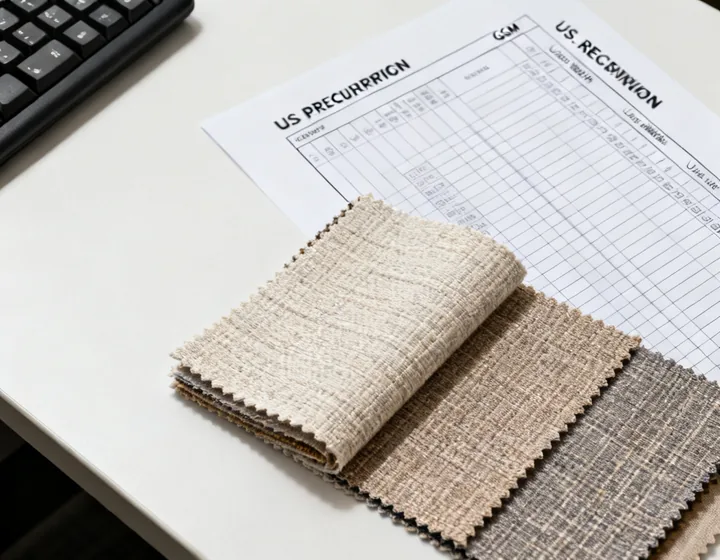
Buyers researching sanderson still need a written article brief before any mill can answer. Record fiber composition, construction, GSM or oz/yd², usable width excluding selvage unless agreed, color reference, finish, quantity with unit, and US destination. Leave unknown fields visible instead of converting guesses into “approved” values.
| Input | Supplier response |
|---|---|
| Composition and construction | Confirm deviations against the retained swatch or written target |
| Finishing, backing and color lot | State process stage, dye-lot policy and test scope |
Sample stages are records, not lead-time promises. A retained swatch screens hand and construction; a lab dip addresses color; a strike-off addresses print; bulk inspection uses separately agreed sampling and defect rules.
Agree deliverable, version and responsible party for composition, GSM, usable width and finish.
Ask each mill to quote the same yield, packing, testing and destination basis so unit prices can be compared.
Record article identity, date, reviewer, decision and permitted deviation. A sample is not the bulk dye lot.
Define roll inspection, shade continuity and document scope before release. Certificates stay tied to the quoted article.
Start from home textile and upholstery applications and an approved reference. Inquiry cards on the product page are generic configurations, not sanderson inventory.
Review inquiry familiesConfirm construction, backing and finish for seating, drapery or contract interiors before requesting mill quotations.
Compare alternatives against the same specification. Mark every fiber, width or finish change as a deviation, not an equivalent.
A retained swatch is a target reference; bulk inspection uses separately agreed sampling and defect rules. Ask for an article-specific data sheet, method, edition, laboratory and date. A mill ISO certificate or an unrelated OEKO-TEX listing is not a product result for this order.
Define seating contact, abrasion basis and cleanability before selecting a construction.
State light exposure, lining, heading and usable width so yield can be quoted honestly.
Record occupancy, flame requirement and backing so test methods can be named, not assumed.
Before the RFQ